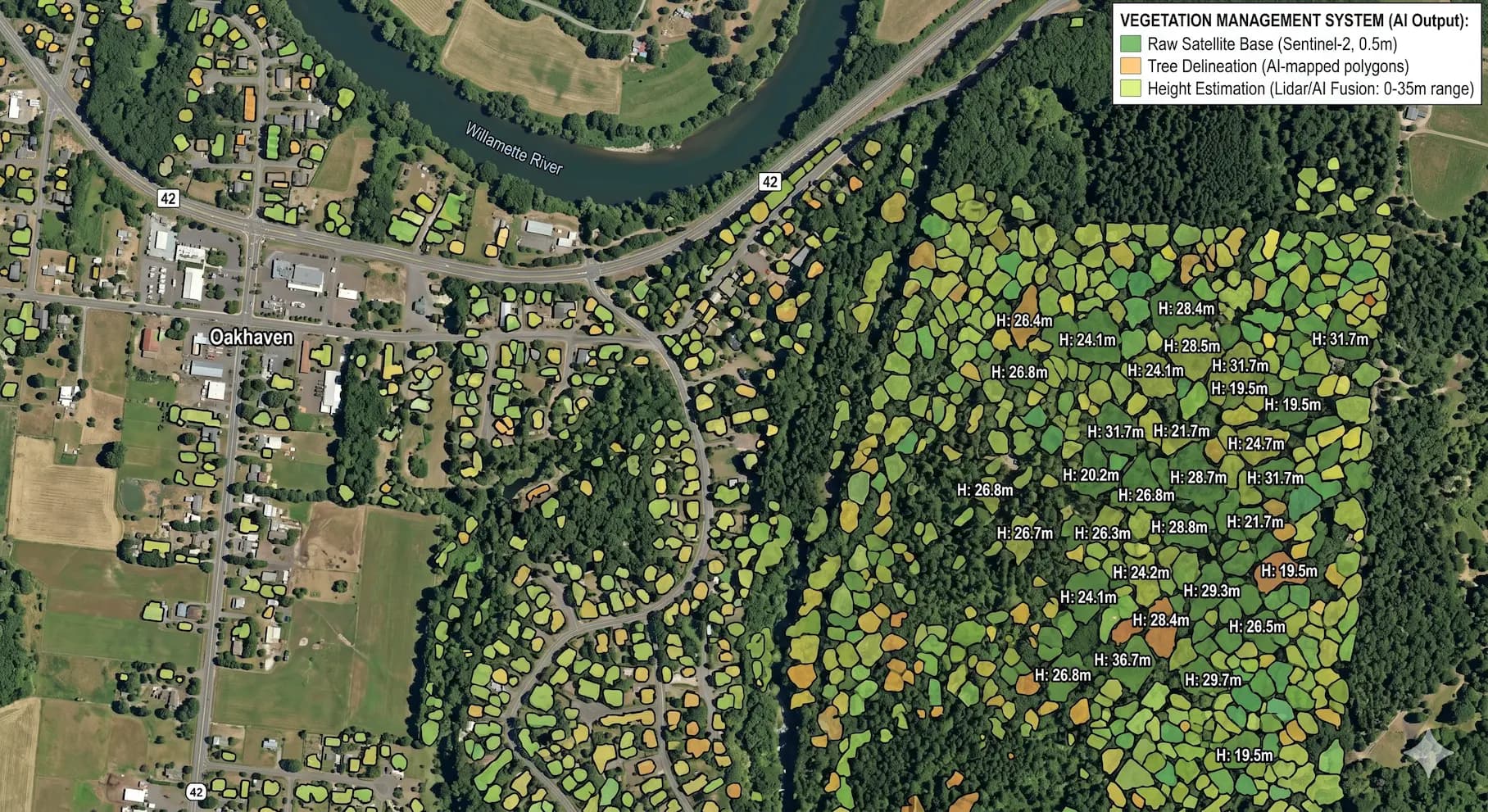
Co-developed a benchmark-leading vegetation management platform with a global energy technology leader, fusing high-resolution satellite imagery, airborne LiDAR, and multispectral data to detect every tree near transmission and distribution lines, model canopy height and growth, and quantify outage and wildfire risk. The system now drives continental-scale risk triage for utility operators across North America, Europe, and Latin America.
The Challenge
Utility operators manage tens of thousands of kilometers of overhead lines crossing forested terrain, and every encroaching tree is a potential outage, fire ignition, or compliance violation. Manual ground inspection cannot scale to continental footprints, and conventional remote sensing pipelines lose accuracy under dense canopy, mixed species, and uneven LiDAR point density. Our partner — a global energy technology leader serving transmission and distribution operators across multiple continents — needed an automated, defensible risk model trustworthy enough to drive multi-million-dollar trim and removal decisions.
Our Approach
We built an end-to-end geospatial AI pipeline that fuses pansharpened Maxar RGB, Sentinel-2 multispectral bands, and airborne LiDAR point clouds. A custom canopy height model built on a satellite-pretrained DINOv3 backbone predicts tree heights up to 50 m, while individual crowns are delineated via Multiresolution Clustering and Watershed Segmentation. On the LiDAR side, a SegmentAnyTree-based 3D segmentation pipeline generates near-ground-truth tree instances directly from point clouds, eliminating most manual annotation cost. The risk engine then computes horizontal, fall-in (3D), and vertical clearances against the line catenary — with optional SAG modeling — and a Sentinel-derived VVI composite (NDVI, GNDVI, RENDVI, NDRE) tracks vegetation health over time to flag dying and hazard trees before they fail.
Results
The platform delivers benchmark-leading accuracy at production scale: 98.39% F1 on forest detection (96.84% precision, 100% recall), canopy height MAE as low as 1.16 m on the highest-resolution deployments and ~2.0 m on continental satellite-only inputs, and 75–77% risk-class agreement with utility field crews. By replacing manual inspection with automated triage — and by bootstrapping training labels from SOTA models rather than expensive hand-annotation — the system gives utilities a repeatable, auditable framework for prioritizing vegetation work, preventing outages, and reducing wildfire ignition risk. The collaboration is ongoing, with active expansion into individual species identification and longitudinal canopy health monitoring.